



One of the grossest (but funniest) things that ever happened to me as a veterinarian occurred as I was treating a five-year-old guinea pig with a large squishy lump on her neck. I determined it was an abscess and decided to drain it and prescribe antibiotics. As I pierced her skin, the force of the fluid inside pushed the needle out – along with a five-foot stream of the smelliest brown liquid I’ve ever experienced! I finished the procedure, even though my assistant kept laughing so hard she had trouble holding the pig still! The lump did grow back (as abscesses can), but at least not quite as large.
Lumps & Bumps Diagnosis in Guinea Pigs
Lumps and bumps (“masses” in medical terms) are not uncommon in guinea pigs, especially as they get older.
Diagnosis always begins with a physical exam by your vet, so if you find a mass on your pig, take him or her in. We can’t tell what a mass might be through a photo or a description; we have to feel it. Once we feel it, we usually perform a fine needle aspirate, which is a non-traumatic procedure that involves using a thin needle to collect some cells from the mass then looking at the cells under a microscope. An aspirate can’t always determine what the mass is, but it usually gives us a good clue. A biopsy of the mass is the best way…but it most often involves surgery to remove it first.
If we think that there may be an internal mass but can’t feel it, x-ray or ultrasound is required. If we’re concerned about a mass having spread to any organs, especially if your pig is also having trouble breathing or eating, we may recommend x-ray or ultrasound as well. Blood work may also be recommended to check organ function.
Cysts
Cysts are some of the most common masses and are usually benign (essentially meaning not cancerous).
- Fluid-filled cysts can occur from trauma or other unknown reasons.
- Sebaceous cysts originate from oil glands and occur because of excess production.
- Follicular cysts originate from hair follicles and usually occur because of inflammation from hair rubbing on bedding, especially soiled bedding.
If your vet has diagnosed a mass as a cyst and it is small, it usually doesn’t need to be removed. If, however, the cyst is large or it interferes with eating, moving around, or breathing, it should be removed. Simply draining a cyst usually won’t work, since a cyst contains a capsule that needs to be removed; if the capsule is not removed the cyst will usually recur. There is a risk for a cyst to burst, become infected, and turn into an abscess, so monitor it for any changes.
Abscess
An abscess is similar to a cyst, but it contains pus and often blood. They are often painful when touched, and sometimes the skin over one is swollen, red, warm, and/or hairless. Abscesses develop a lot faster than cysts do, so you might see an abscess when the previous day nothing was there. They occur from trauma/injury such as a bite wound or puncture or from dental disease or other internal infection.
Abscesses require prompt veterinary attention. They need antibiotics in addition to drainage and flushing or removal. In the case of dental abscesses, sometimes the affected tooth/teeth need to be removed in order to keep the abscess from recurring.

Enlarged Lymph Nodes
An enlarged lymph node can seem like a mass. Certain diseases can cause infection or widespread inflammation, which can cause lymph nodes to swell. Certain cancers such as lymphoma and leukemia (see below) can also cause this to occur. In order to tell the difference, we take an aspirate of the lymph node and look at it under a microscope.
If the reason for the lymph node enlargement isn’t cancer, your pig will likely be put on antibiotics and an anti-inflammatory pain medicine.

Tumors in Guinea Pigs
A tumor is a mass of abnormal cells. Benign tumors usually grow slowly and don’t spread to other parts of the body. Malignant tumors can invade the nearby lymph nodes and spread elsewhere in the body. The causes of tumors in guinea pigs aren’t known for sure.
Tumors are more common in older guinea pigs but can be seen in young ones. About a fourth to a third of guinea pigs I’ve seen older than three years old have had some type of tumor. More than half of females I’ve seen older than three years who haven’t been spayed have uterine or mammary cancer.
The treatment for a tumor is almost always surgical removal, with a little extra tissue around it taken off as well in case the tumor is larger than it looks. Occasionally chemotherapy or radiation is also an option. And depending on how advanced a tumor is or its prognosis, palliative care may be recommended instead in order to maintain a good quality of life.
Skin tumors
The two most common types of skin tumors are trichofolliculomas (hair follicle tumors, usually on the rump) and lipomas (fatty tumors). They are slow growing and benign; however, follicular tumors can become ulcerated and produce discharge. In this case, they would need to be treated, often with surgery. And lipomas can sometimes contain cancer within them, as I occasionally discover when removing them. So if a fatty tumor grows quickly – or if any benign tumor is in an inconvenient location for your pig – it should be removed. If the mass is fully removed, the prognosis is usually good.
Mammary gland tumors
Mammary gland tumors are relatively common in older guinea pigs and can occur in both females and males. About half are benign fibroadenomas, and about half are malignant fibroadenocarcinomas or fibrosarcomas. The most common sign of a mammary gland tumor is a lump within the mammary tissue. Sometimes instead of one mass there are several small firm ones. Occasionally the mass/masses could be ulcerated or have either clear or bloody discharge. Unless the tumor has spread and if the mass is fully removed, the prognosis is usually good.
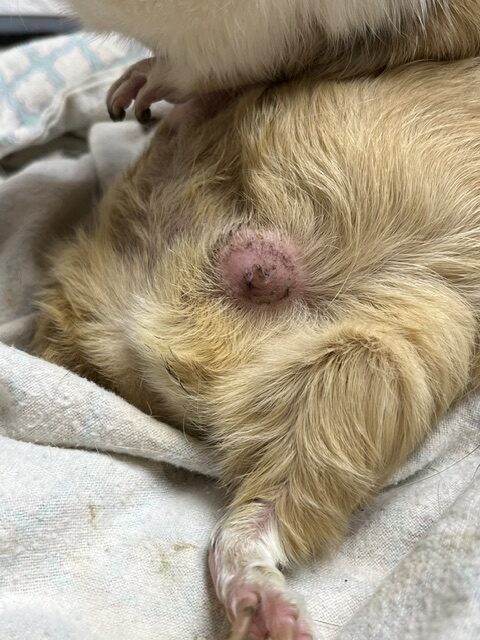
Mammary gland tumor on 3 1/2-year-old female Remi. (Owner: Pamela Rugg. Photographer: Amy “Brem” Bremers)
Lymphoid tumors
T-cell lymphoma and lymphocytic leukemia are the two types of lymphoid tumors, with lymphoma more common in older pigs and leukemia in younger ones. Signs include enlarged lymph nodes, decreased appetite, weight loss, poor-looking hair and skin, and lethargy or weakness. Lymphoma can include eye changes. Unfortunately, guinea pigs typically live only a few weeks after signs start. This is why having a fine-needle aspirate performed to distinguish these tumors from inflammation is important.
"Invisible" Masses
Uterine and ovarian tumors
Sometimes veterinarians can feel a uterine tumor (usually a leiomyoma) or an ovarian tumor (usually a teratoma) during an exam of an unspayed female, but not always, particularly if she is overweight. These tumors can be benign or malignant; however, even benign ones can cause problems. Signs include abdominal pain, bloody discharge, bloody urine, and a distended abdomen. The only treatment is to spay; as long as your vet gets the entire uterus and ovaries, the tumor won’t recur.
Lung tumors
Bronchogenic papillary adenomas and other lung tumors cause signs that are similar to pneumonia: difficulty breathing, coughing, sneezing, nasal discharge, lethargy, and decreased eating. Lung tumors are benign in that they don’t spread; however, if large they do cause concerning issues, such as difficulty breathing. Since signs are so similar to pneumonia, x-rays are necessary to diagnose. Usually treatment involves just treating the signs.
Other organ tumors
Other sites of tumors include the bladder, liver, kidneys, and intestine, but these are much less common.
If you feel a lump or bump on your guinea pig, bring him or her in to your vet as soon as you can. We always want to diagnose and begin treatment as soon as possible.
Copyright 2026 Amy “Brem” Bremers, DVM